
 80813-00200


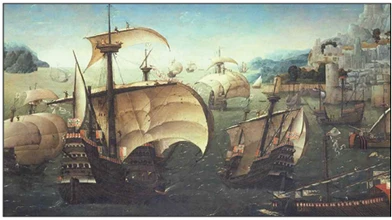
The Arrival of Europeans in India came about when the Portuguese arrived in the late 15th century due to the desire to locate profitable trade routes and spices. In 1498, Vasco Da Gama arrived in Calicut, which provided the first direct shipping route between Europe and India.
Other Europeans who included the Dutch, the English, the Danish and the French soon arrived and set up trading stations. Through time, the European trading companies evolved from being traders to becoming involved in politics, capitalizing on the rivalry that existed amongst the Indian States. The East India Company, an English company, became the dominant force.
About Advent of Europeans in India
- When Vasco da Gama, a Portuguese explorer, arrived at Calicut on the southwestern coast of India in 1498, he discovered a new (all-sea) trade route around Africa via the Cape of Good Hope to India.
- This discovery culminated in European efforts to search for a new, all-sea trading route to India.
- In this endeavour, Christopher Columbus, a Spanish explorer, reached and discovered America in 1492.
Reasons of Arrival & Need for New Trading Routes
- In popular Western imagination, India was a fabled land of riches and highly profitable trade. Many foreign rulers had invaded India for its fabulous wealth.
- Besides the plundering raids, a highly profitable trade between India and Europe dates back to ancient times.
- Indian cloths, spices, and drugs have been in great demand in Europe since the Roman Empire.
- Initially, this trade between East and West was carried on along several routes, but at the beginning of the late fourteenth century, changes in the geopolitical conditions in West Asia and Europe forced the traders to search for new routes.
The changes or causes that led to the search for new trading routes have been discussed in detail in the following section.
Geographical Causes
- Unstable Land Route: In the Middle Ages (5th century CE to 15th century CE), traders preferred the land route from the Middle East to Europe.
- However, with the rise of Arabs in the tenth century and their plundering raids along the route, the land route became unstable and dangerous for trade.
- Safe Passage through Water: While the land with some passes fell within the territory of one or the other kingdom, the oceans and seas had not yet been controlled and thus offered a safe passage.
Technological Causes
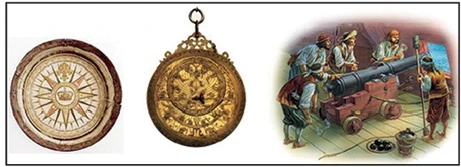
- Navigation: The period witnessed several technological advancements. The advancements in navigation (astrolabe for fixing the height of heavenly bodies for navigation and mariner's compass) by the Arabs and shipbuilding by the Europeans at a time when land routes had become unstable made waterways a natural choice.
- Use of Gunpowder: Gunpowder, invented in China in the ninth century, spread to Eurasia by the end of the thirteenth century.
- As sea voyages gained popularity in the fifteenth century, canons and gunpowder began to be used on ships to protect them from attacks.
- Gunpowder kept ships safe from attacks, adding more firepower, making them easier to carry and more stable, and helping to make the most destructive weapons of the time.
Political Causes
- Monopolies: The merchants of Venice and Genoa monopolised the trade between Asia and Europe.
- The western side, the Mediterranean area, was under the merchants of Venice and Genoa, and the eastern side, the Asian side, was under the Arab merchants.
- These merchants did not allow new merchants from other West European countries to trade through the old routes under their control.
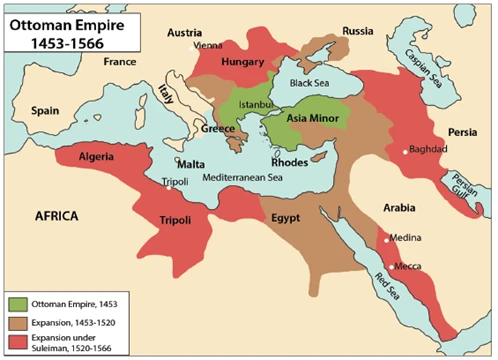
- Ottoman Empire: The Ottoman Turks captured Constantinople in 1453 and established the Ottoman Empire, stretching from Syria to Egypt.
- This brought the old routes under Turkish control. Moreover, the expansion of Turkish power in Eastern Europe and the growth of the Turkish navy alarmed the Europeans.
- Rise of New Nation States: The later part of the 15th century saw the rise of centralised states with strong kings, like Spain and Portugal, who were keen to trade with Asia.
- The Kings encouraged, often supported and sponsored geographical explorations and navigators.
Economic Causes
- Economic Growth in Europe: The European economy expanded rapidly due to the expansion of land under cultivation, the introduction of improved ploughs, and scientific crop rotation. As a result of this growth, towns rose, and trade increased.
- Demand for Spices and Pepper: The economic revival in Europe increased the demand for spices and pepper needed to make meat palatable.
- Tolls and Taxes: Tolls and taxes were constantly increased on the European and Asian trade sides, reducing profit margins.
- Profit Maximization: Although trade between Asia and Europe was carried on along several routes, it was highly profitable. However, raids along the land route and monopolies by various groups had reduced profits. Thus, there was an attempt to maximise profit through new trade routes.
Psychological Causes
- Renaissance: The cultural revival or Renaissance in Europe during the fourteenth century infused a spirit of daring and adventure among the people of Western Europe.
- Glory: Above all, the desire to achieve glory acted as an inspiring factor for navigators and explorers.
- Mercantilism: A set of economic doctrines and policies involving state intervention to promote national prosperity and strength, mercantilism gripped the European states in its clutches.
Religious Causes
- Proselytising Zeal: The explorers were motivated to spread Christianity into the new lands.
FAQs about Europeans
Who was the first European to come to India via sea route?
Vasco Da Gama, the Portuguese explorer, reached the port of Calicut in 1498 and opened the sea route from Europe to India.
What was the first European Power to come to India?
Portuguese were the first European Power to arrive in India in the latter part of the 15th century.
Which European companies came to India?
Portuguese, Dutch, English, Danes and French came to India.
Why did Europeans come to India?
The Europeans came to India for trading in spices, textiles and other goods.
What European power ruled India?
English came out victorious in military conflicts and diplomatic maneuvers to dominate India.
